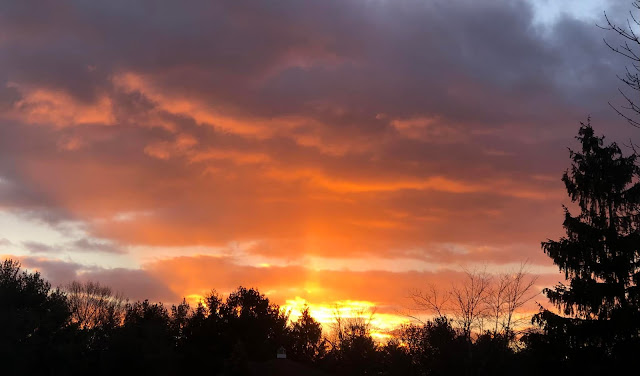
I took this photo of the sunset one day last week and thought that I had seen a lot of distinctively beautiful sunsets so far this winter. Looking back through my pictures, I found at least seven in just the last three weeks. I started to wonder if I was just noticing sunsets more often, taking more photos, or if lovely sunsets really occurred more often in the winter. It seems that there may be some scientific reasons for sunsets being better during the winter.
NOAA meteorologist Stephen Corfidi says that the peak sunset season for the Northeastern United States is November through February due to several meteorological factors. Those factors are lower humidity and cleaner air. This allows more saturated colors to reach our eyes, and because twilight lasts longer closer to the solstices, sunsets also last longer.
Clouds figure into the picture, too. Well-defined cloud systems are more likely to happen in the winter, and they can provide a backdrop for the setting sun and reflect the beautiful colors back to those viewing the sunset.
I've simplified the explanation a bit because it involved words like "spectrally pure" (vibrantly colored) and "Rayleigh scattering" (the scattering of light by particles much smaller than the wavelength of the radiation). But if you'd like to read more, you can read the original Vox article here. And for a real primary source, here is Dr. Perfidi's original paper (complete with further reading on the physics and meteorology of the twilight sky).
Or maybe you don't need any further reading but just want to get out and view beautiful winter sunsets. Enjoy, whatever approach you take!


